Non-invasive EEG systems
Proprietary dry-gold-electrode systems with real-time acquisition, wireless connectivity and personalized neurofeedback — commercial products used by paying customers for monitoring, research and neuroplasticity programs.
I build systems at the intersection of neuroscience, AI, medical robotics and human enhancement — connecting measurement of the brain with intervention, and verifying the individual response.
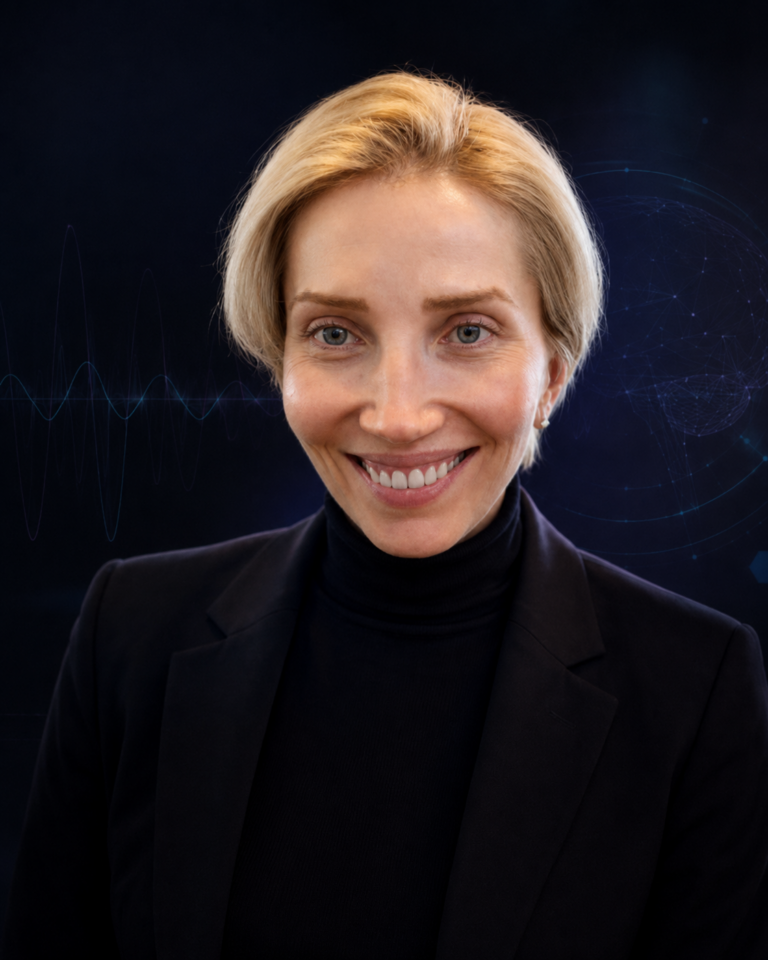
I am a physician, mathematician, AI researcher and neurotechnology founder. My work focuses on brain–computer interfaces, programmable neuroplasticity, medical robotics, brain imaging and AI-native discovery of cognitive interventions.
I have authored 40+ scientific papers, developed 7+ patents, and built and led an interdisciplinary R&D team of 50+ engineers, scientists, physicians and product specialists. Previously I co-founded and helped build a Swedish technology company that received an independent valuation range of $200M–$1B. Currently I am building Adapta — a full-stack platform combining BCI devices, personalized brain models, neuroplasticity programs and continuous measurement of brain response.
A track record across science, engineering, clinical practice and company-building.
Scientific papers authored
Patents and patent applications
Engineers, scientists, clinicians and product specialists led
Valuation range of a previous startup I co-founded and led as CEO
Paying BCI customers
Participants with measurable regional cortical-thickness increases in an exploratory longitudinal study
From dry-electrode hardware to AI-native discovery — measurement connected to intervention.
Proprietary dry-gold-electrode systems with real-time acquisition, wireless connectivity and personalized neurofeedback — commercial products used by paying customers for monitoring, research and neuroplasticity programs.
Combining MRI, EEG, cognitive tests, genetics, epigenetics, biochemistry and behavioral data to design and verify individualized interventions — and measure whether they actually change the individual brain.
An endovascular robotic neurosurgery system and its AI-assisted navigation stack: vascular imaging pipelines, datasets, and VeNet — a lightweight network for brain-vessel segmentation.
Systems for computational screening and experimental validation of compounds and pro-cognitive formulations, linking biological activity with measurable cognitive and brain-response data.
Adaptive EEG algorithms, real-time signal-processing pipelines and online personalization methods for individual brain-signal models.
Full-stack neurotechnology for programmable neuroplasticity.
Adapta is being formed in the United States through the consolidation of technology and operations developed by NeuroSputnik and Nimbus BCI. It brings the whole loop under one roof:
A selection across BCI, medical robotics and AI-native pharma. Full portfolio on the research site.
Brain–Computer Interfaces
Introduces BOID, an interpretable measure of active oscillatory degrees of freedom in brain activity. A multimodal prognostic model with BOID reached AUC 0.81 in 575 post-cardiac-arrest patients.
A lightweight mathematical method for estimating the number of active oscillatory components in non-invasive EEG recordings.
A resource-efficient pipeline combining Hankel-based signal processing with real-time classification for edge BCI systems.
A geometric framework connecting the observable topology of time series with the structure of the dynamical systems that generate them.
Non-invasive EEG hardware, personalized signal-processing pipelines, real-time mental-command recognition, closed-loop neurofeedback and adaptive BCI software.
Medical Robotics
A compact 3D segmentation architecture for brain-vessel imaging, surgical planning and endovascular robotic-surgery workflows.
100 expert-validated, manually annotated cerebral MRA volumes focused on the Circle of Willis, reviewed by three neurovascular surgeons.
A robotic motion-copying platform for remote endovascular neurosurgery, combining haptic feedback with patient-specific preoperative simulation.
A patient-specific system that reconstructs cerebral vasculature from medical imaging for procedural planning and rehearsal.
A cybersecurity framework addressing communication failure, unauthorized control and other risks in time-critical remote robotic surgery.
AI-Native Pharma & Cognitive Interventions
A computational and experimental study combining in-silico discovery with biochemical validation of previously uncharacterized protein interactions.
A proprietary platform for computational screening, prioritization and experimental validation of compounds and pro-cognitive formulations.
Individualized cognitive-intervention programs combining biological profiling, AI-guided formulation design, cognitive testing and repeated measurement of response.
Exploratory studies of how personalized interventions affect cognitive performance, EEG markers, structural brain measurements and longitudinal brain-age estimates.
I started in mathematics and medicine because I wanted to understand complex biological systems rigorously. Over time, I realized that measuring the brain was not enough: the real challenge was to connect measurement with intervention and verify the individual response. This required building across disciplines — electronics, signal processing, AI, medical imaging, biology, robotics and product development.
My long-term goal is to make brain adaptation measurable, personal and eventually programmable.
Open to researchers, clinicians, investors and founders in neurotech, AI, brain longevity, medical robotics and human–AI systems.
Also on LinkedIn · Google Scholar · ORCID